
Anthropic's Best Model Is Enterprise-Only, OpenAI Buys Another Distraction with TBPN, & AI Agents Are Breaking the Internet
Frontier AI is getting locked behind enterprise budgets, OpenAI keeps losing focus while Anthropic and Google gain ground, and GitHub can't handle the code tsunami
Anthropic Reserves Mythos for Enterprises
Anthropic’s newest model Mythos is supposedly incredible, and blows the doors off their rivals.
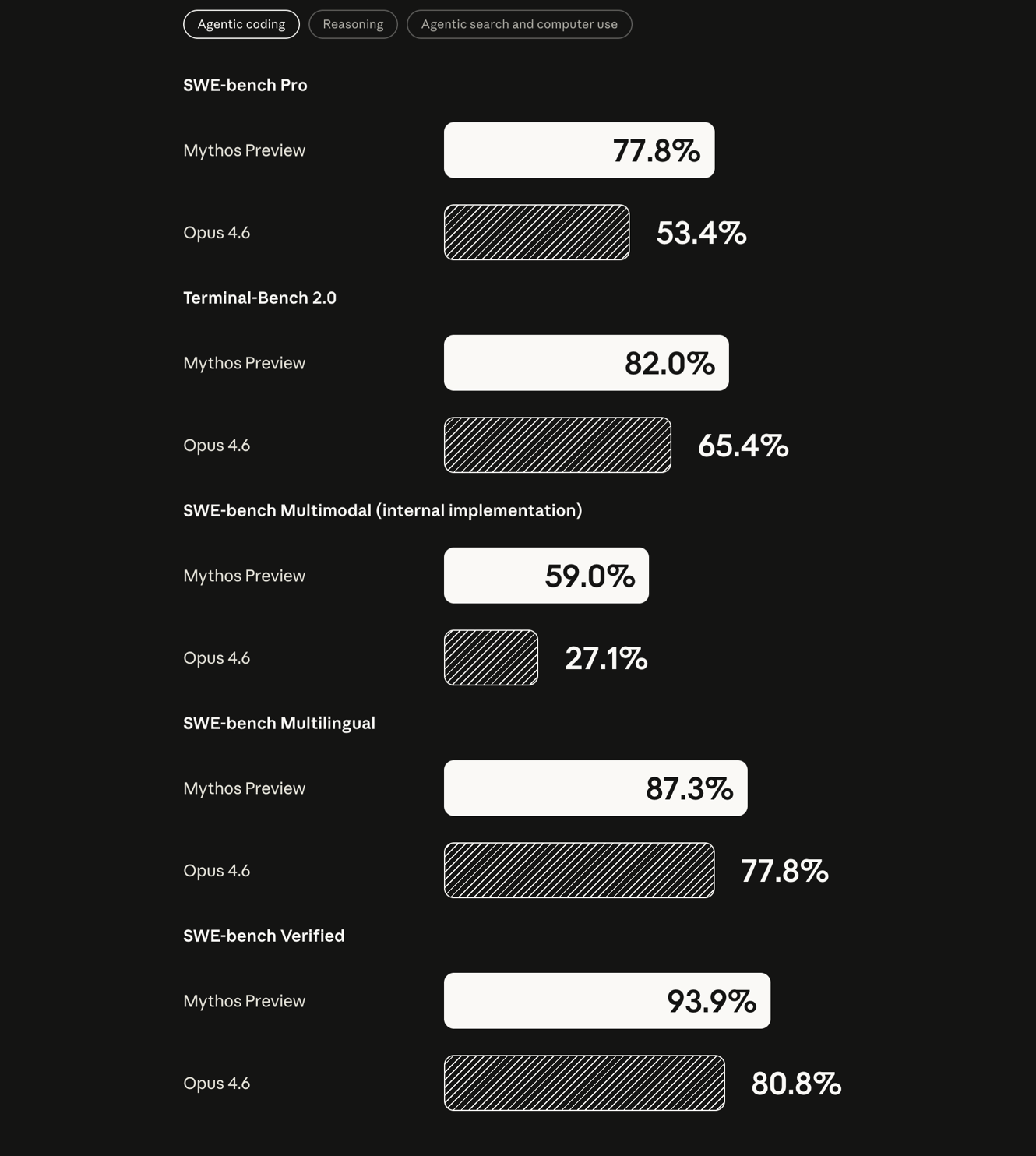
So much so that they’re giving 50 companies a preview so they can find software vulnerabilities through Project Glasswing. Companies include Amazon, Microsoft, Apple, Google, and the Linux Foundation.
Mythos has already found thousands of high-severity vulnerabilities, including bugs in every major operating system and web browser. Some of these flaws survived decades of human review and millions of automated security tests.
This is likely the first frontier model trained on Nvidia’s Grace Blackwell NVL72 architecture, and is incredibly expensive. Mythos Preview costs $25/$125 per million input/output tokens. That is 5x Opus 4.6’s $5/$25, which is already far more expensive than GPT-5.4’s $2.5/$15.
Given the price tag, it makes you wonder if Anthropic’s preview is about safety, or about having enough compute.
Another reason could be distillation. In February, Anthropic accused DeepSeek, Moonshot AI, and MiniMax of running 24,000 fraudulent accounts and 16 million distillation queries against Claude. That’s less possible if you limit this to vetted enterprises.
Finally, it’s convenient. The users complaining loudest about throttling and restricted access aren’t contributing much to Anthropic’s bottom line. Why not remove that headache and capture more of the enterprise?
This also means that if you don’t have a big budget, you no longer have access to frontier models. Anthropic is committing up to $100 million in usage credits for Glasswing partners and $4 million to open-source security organizations. That’s great for Amazon and Microsoft. For everyone else, frontier AI is becoming less democratized.
OpenAI Buys Another Distraction with TBPN
OpenAI acquired TBPN, a tech-focused daily talk show that averages 70,000 viewers per episode. The Financial Times reported the deal was “low hundreds of millions of dollars.” TBPN has 11 employees, launched in October 2024, and generated about $5 million in ad revenue last year. It was on track for $30 million in 2026.
6x ad revenue YoY is solid, so the price tag makes sense, but what is OpenAI getting out of this? TBPN is there, profitable, and friendly with tech. OpenAI executives were on the show, so what’s different now that OpenAI owns them?
OpenAI just raised $122 billion at an $852 billion valuation and the only place I can see TBPN helping is with vibes, but how much will that help now that OpenAI owns them?
If OpenAI wants to improve their public perception, a private eight-figure ad deal would have made more sense than a public nine-figure acquisition. Now TBPN’s credibility is in question, and OpenAI has a new distraction with media. The show will report to Chris Lehane, OpenAI’s chief global affairs officer, not the product team. That tells you everything about the intent.
There are rumors GPT-6 is imminent and that it’s great, hopefully that forces Anthropic’s hand with pushing out Mythos. OpenAI has been great with model quality, but how much are these distractions causing OpenAI to lose share to Anthropic in the enterprise and Google in consumer?
AI Agents Are Breaking the Internet
Three stories from the last week, all pointing at the same thing.
GitHub is Overwhelmed
A project called The Missing GitHub Status Page tracks what GitHub stopped reporting: aggregate uptime numbers, and the data is ugly.
February 2026 alone produced six separate incidents, including a nearly six-hour Actions outage. COO Kyle Daigle acknowledged on X that the platform is struggling.
GitHub logged 1 billion commits across all of 2025, and is now seeing 275 million commits per week, a pace that would produce 14 billion for the year. AI-agent pull requests jumped from roughly 4 million in September to 17 million in March.
App Store has Similar Issues
New iOS app submissions surged 84% year-over-year in Q1 2026, hitting 235,800 submissions. Developers are reporting review delays of 7 to 30+ days, against a historical baseline of 24 to 48 hours.
Apple is cracking down on vibe-coded apps while simultaneously integrating agentic coding tools into Xcode. Not every new app is vibe-coded, but enough of them are moving the numbers.
Anthropic Cut Off 3rd Party Coding Harnesses like OpenClaw
Users need pay-as-you-go billing instead of subscription limits. Boris Cherny, Head of Claude Code, said subscriptions “weren’t built for the usage patterns of these third-party tools.” People are upset, but I don’t think they realize how much Claude Code is subsidized. I asked Claude Code about how much my month of consumption would have cost by API.
Instead I pay $200 per month. Now imagine if I had OpenClaw running autonomously.
Subscription pricing is untenable when you remove human friction and replace it with an agent that never sleeps and has no incentive to conserve tokens.
AI is removing the friction that kept code production, app submissions, and API consumption at manageable levels. The Internet’s distribution layer was built for human-speed input, yet agents are machines.
GitHub needs to handle orders of magnitude more commits. Apple needs to review orders of magnitude more apps. Every API provider with flat-rate pricing needs to rethink their model. Agents are only going to make this worse. The code tsunami is here, and the plumbing wasn’t built for it.


