



Coinbase Pays for the AI Layoff Optics
If you lay people off due to AI, you will be held to a higher standard. Coinbase just learned this in the most public way possible.
On May 5, Coinbase cut 14% of staff (about 700 employees), and Brian Armstrong told the world his AI-native engineers were shipping in days what previously took weeks. On May 7, Coinbase missed Q1 earnings: $1.41 billion in revenue (4.7% miss), a $394 million GAAP loss, stock down 5% after-hours. On May 8, an AWS data center in US-East-1 overheated when multiple chillers failed, and Coinbase went dark for seven hours.
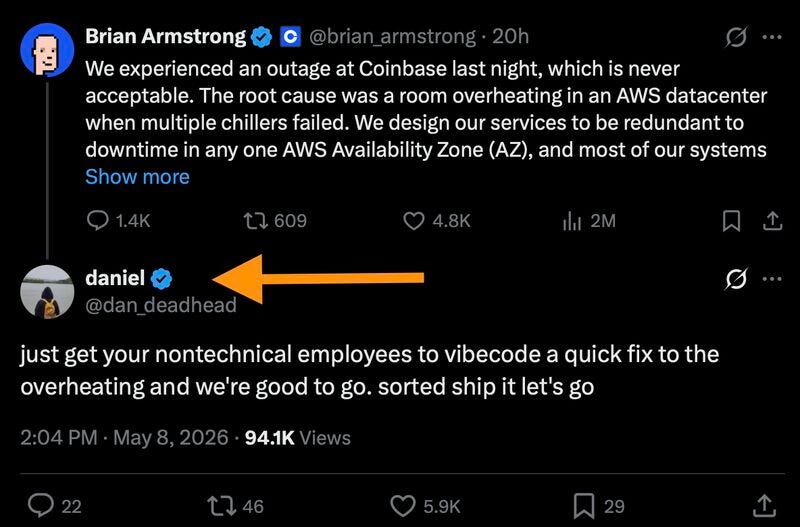
CEO Brian Armstrong was quickly ratioed by someone who told him to “vibecode a quick fix”.
The technical postmortem is worse. Coinbase’s primary exchange runs in a single AWS Availability Zone “to minimize latency,” and the failover systems didn’t work as designed. Engineers had to manually execute disaster recovery. Armstrong, who days earlier credited AI for replacing engineers, said Coinbase would now “revisit how its exchange infrastructure handles AZ failures.” This is a problem multi-AZ deployments solved 15 years ago.
The earnings miss makes the rest obvious. Crypto trading volume was down, and the 14% cut was a margin response to a revenue shortfall. Cyclicality, not AI productivity, drove the timing. But Armstrong handed every critic a free script the moment he attributed the cuts to AI.
This matters because Meta starts its 8,000-person layoff on May 20, explicitly citing AI capex and productivity. Microsoft is mid-buyout for 8,750 US employees with the same framing. The Coinbase episode is the dress rehearsal. The next time Instagram, Threads, or WhatsApp ships a high-profile bug, Zuckerberg can expect the same response.
For any company citing AI in a layoff announcement: if your product goes down afterwards, expect a harsh reaction from your users. You can’t let your product slip after cutting costs, especially with so many worried about AI replacing their jobs.
A quick note from me.
This whole issue is about AI moving jobs around, but how does it impact pay? The people adding AI skills to their roles are seeing the biggest pay jumps in the market.
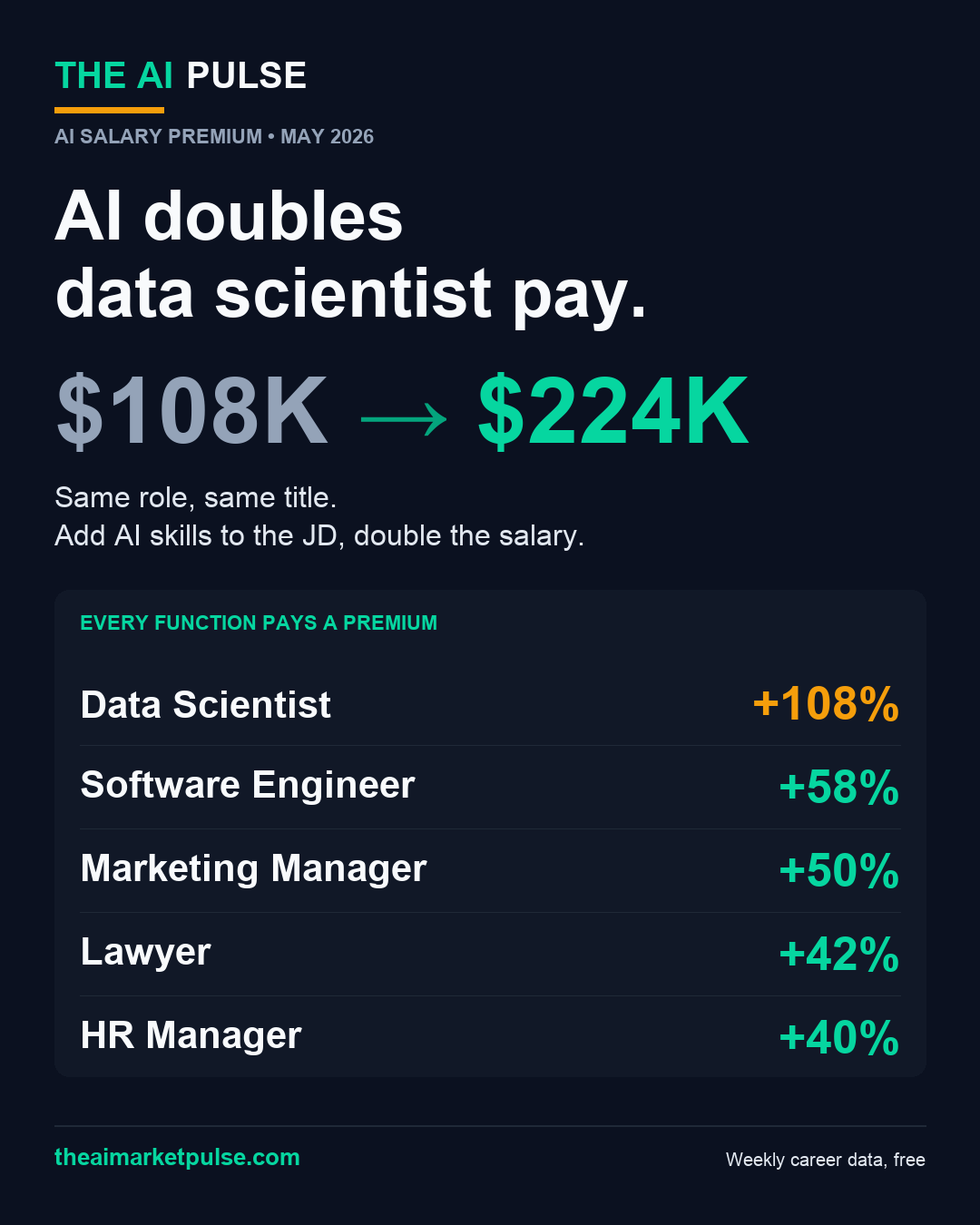
That’s from AI Pulse, where I track 22,000+ jobs weekly across 42 roles and 14 industries to show what share of your field now requires AI skills and how much more those jobs pay.
Curious how AI is reshaping your career and your field? Subscribe free →
The FDE Wars Begin at Frontier Labs
Last week we wrote that Anthropic and OpenAI were vertically integrating into the AI consultancy lane with their joint ventures, and now frontier labs are picking up steam.
On Monday, OpenAI launched The Deployment Company with $4 billion in initial capital and 19 founding partners (TPG, Bain, Brookfield, Goldman, SoftBank, Warburg Pincus, BBVA, Advent, B Capital, Emergence, Goanna, WCAS and others).
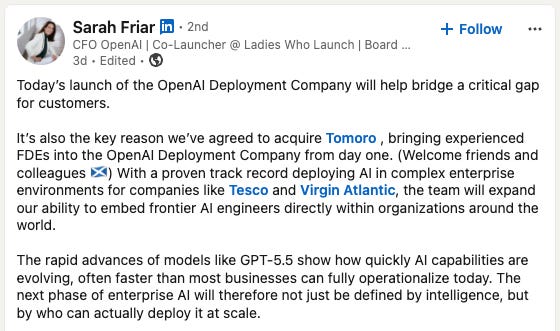
Same day, OpenAI acquired Tomoro, a 150-person Scottish AI consulting firm with Mattel, Red Bull, Tesco, and Virgin Atlantic on the customer list. Tomoro becomes the founding engineering bench. OpenAI keeps majority control. The job title for everyone joining is “Forward Deployed Engineer.”
Google responded on Tuesday, as Thomas Kurian announced a Google Cloud FDE team on LinkedIn, $750 million in deployment funding, and partnerships with Accenture, Capgemini, Cognizant, Deloitte, HCLTech, PwC, and TCS. Matt Renner, Google Cloud’s CRO, framed it as “more technical resources vs. just an ocean of salespeople.”
The “Forward Deployed Engineer” title was Palantir’s invention. For 20 years, it described an engineer embedded inside a customer to rebuild their data plumbing so the software actually worked. By investing so much with customers, the switching costs for leaving became astronomical.
Now OpenAI, Anthropic, and Google are all hoping the same in enterprise AI. The labs spent years hoping models would sell themselves, yet AI is still behind outside of engineering and data analysis.
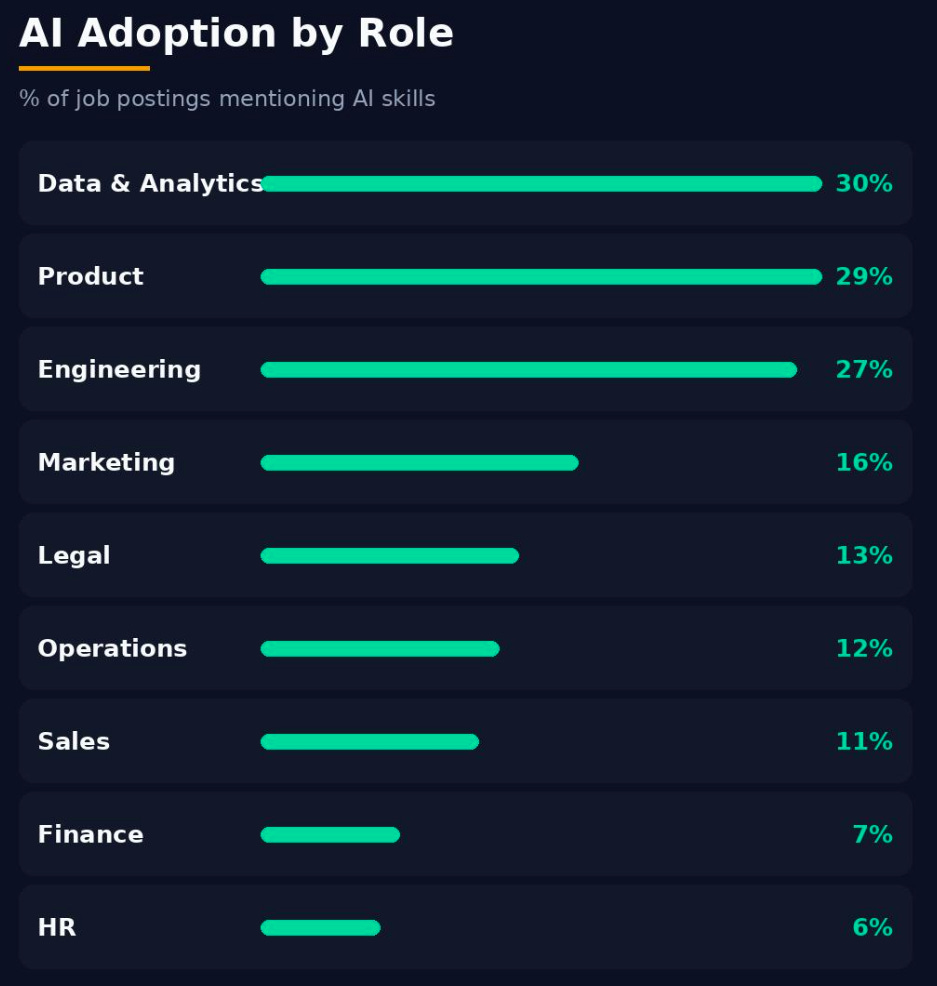
Clearly AI consultancies on the integrator thesis haven’t made enough traction, and the frontier labs will try closing that gap.
It worked for Palantir, but these projects can take years. Given how fast AI is moving, will enterprises commit to one lab for that long?
Why Google Front-Ran Apple’s WWDC
On Tuesday, Google ran The Android Show 2026 and rebuilt Android around Gemini Intelligence. Sameer Samat, Google’s Android lead, stated “We’re transitioning from an operating system to an intelligence system.”
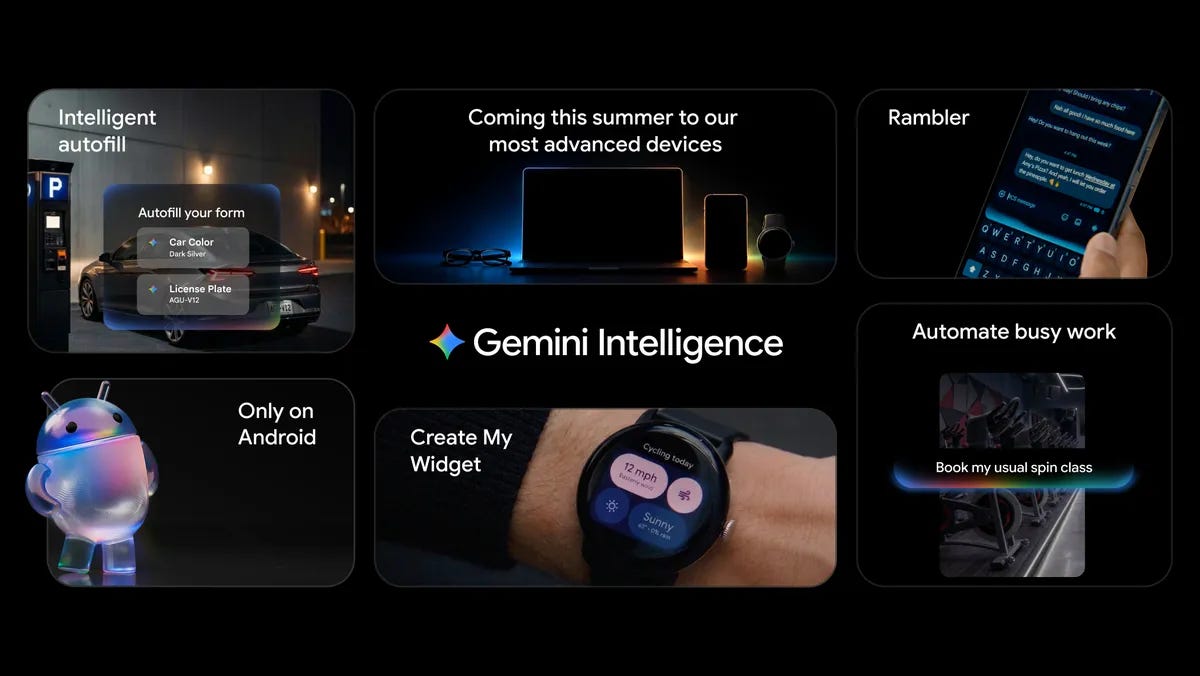
Google didn’t have to go first. Apple’s WWDC is June 8, and that’s where Apple will showcase their Siri overhaul. Google chose to run its show three weeks ahead of Apple’s. The question worth asking is why.
Start with what Google already won. Apple’s new Siri runs on Gemini. Apple confirmed it in January: about $1 billion a year for a 1.2-trillion-parameter Google model, white-labeled as “Apple Foundation Models.” Google Cloud’s Thomas Kurian reconfirmed it publicly at Google Cloud Next on April 22.
But the Apple deal gives Google everything except the one thing that compounds: consumer brand credit. Apple white-labels Gemini. When a billion iPhone users talk to the new Siri, they will think “Apple Intelligence,” not Google.
Which is why I think Google ran three weeks early. When Apple shows off Siri at WWDC, the press now has Gemini as a reference point, and Apple becomes the company catching up to a demo Google already gave.
It also forces a comparison Apple loses on timing: Google’s Gemini Intelligence features ship this summer on Pixel and Galaxy, while Apple’s full conversational Siri doesn’t arrive until later this year.
The bigger picture is that Google is now the only company contesting both layers at once. The labs are vertically integrating into the enterprise, and while Google is following suit, they keep investing more in the consumer market, betting they’ll be the AI brand that defines the category.
Apple is betting the model layer commoditizes: Gemini becomes one swappable engine among many, and the brand customers see still says Apple. Google is betting the opposite, that whoever owns the model owns the distribution, the same way it owned Search.
The Signal
3 takes that didn’t fit above, plus one bet.
1. AI stocks crack on May 12, and the picks-and-shovels names took the hit. On Tuesday, Intel slumped 9.8%, Micron dropped 7.4%, and CoreWeave fell 10.1%. All three had run 60% to 180% YTD before the cut. The market is differentiating “AI exposure” (everyone has it) from “AI margin” (only the labs and Nvidia have it). South Korea’s Kospi opened the selloff after the government floated a windfall tax on AI profits. Will that be the script Japan, Germany, and the EU run next?