



From Chatbot Arena to a $100 Million Company
LMArena started as a research project. In 2023, a group of UC Berkeley SkyLab researchers built Chatbot Arena under the LMSYS (Large Model Systems Organization) umbrella. The concept was simple: show users two anonymous AI model responses side by side, let them pick the better one, and use the votes to generate rankings. No corporate benchmarks, no hand-picked evaluation sets. Just blind human preference at scale.
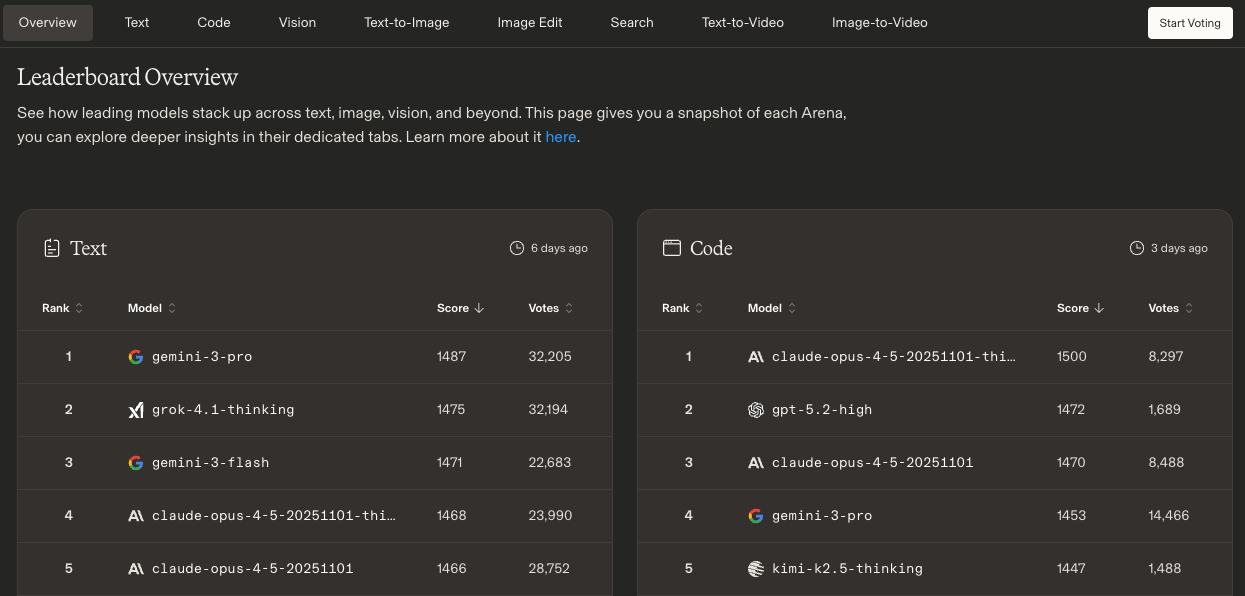
It worked, and Chatbot Arena became the industry’s most-cited AI leaderboard within months. Model labs began timing their releases around Arena rankings. Enterprise buyers started referencing Arena scores in procurement decisions. By mid-2025, the platform’s usage had surged 200% year-over-year.
The team rebranded to LMArena, graduated from LMSYS, and raised $100 million from Andreessen Horowitz. We covered the raise here. The platform moved from lmsys.org to arena.ai. What had been an academic experiment was now a business, and its rankings carry real financial weight.
How the Rankings Actually Work
LMArena uses the Bradley-Terry rating system, a statistical model originally developed for paired comparison experiments. It functions similarly to chess Elo ratings: models gain or lose points based on head-to-head human votes. When you visit arena.ai, you are shown two anonymous model responses to the same prompt. You pick the one you prefer. Your vote adjusts both models’ scores. Multiply that by millions of votes and you get a ranking that reflects aggregate human preference.
The key advantage over traditional benchmarks is that LMArena is harder to game. You cannot optimize for it the way you can memorize MMLU questions, because the evaluation is based on open-ended human preference across unpredictable prompts from real users. There is no fixed test set to overfit on.
LMArena also applies “style control” to its rankings, adjusting for the tendency of users to prefer longer, more verbose responses regardless of quality. Without this adjustment, models that pad their outputs with unnecessary detail would score higher. The style-controlled leaderboard better reflects actual helpfulness rather than superficial polish.
The platform now runs leaderboards across multiple categories: text (general chat), code, math, hard prompts, vision, and more. Each uses the same Bradley-Terry methodology but with category-specific prompts. This matters because a model that excels at creative writing may perform poorly on code, and the overall Elo can obscure these differences.
Where Claude Stands on the Leaderboard
As of early 2026, the LMArena text leaderboard has become a three-way race at the top. Gemini 3 Pro leads overall with an Elo score approaching 1500, making it the most broadly preferred model in blind comparisons. GPT-5.2, added to the leaderboard in December 2025, is the top performer on reasoning-specific benchmarks, particularly with extended thinking enabled. Claude Opus 4.5 holds the strongest position in coding and software engineering.
The category-specific results matter more than the overall ranking for most practical purposes. Claude Opus 4.5 was the first model to break 80% on SWE-bench Verified, scoring 80.9%. Anthropic’s coding momentum has been building since Claude Sonnet 4.5 set the standard in October 2025. SWE-bench is the benchmark that drops models into real GitHub repositories and asks them to fix actual bugs. This is not a toy coding test. The model must navigate a full codebase, understand the issue from a GitHub ticket, identify the relevant files, and produce a working patch. In 2023, the best AI systems could solve just 4.4% of SWE-bench problems. By late 2025, Claude Opus 4.5 reached 80.9%. For enterprise buyers evaluating AI for software development workflows, that trajectory is more relevant than overall Arena Elo.
On GPQA Diamond, the graduate-level science benchmark where PhD experts only score 65-74%, Gemini 3 Pro leads at 92.6%. GPQA Diamond contains 448 questions in biology, physics, and chemistry specifically designed to be “Google-proof,” meaning non-experts cannot answer them even with 30 minutes of unlimited web access. The fact that AI models now exceed human expert performance on this benchmark is itself a milestone.
On the original MMLU benchmark (57 academic subjects, multiple-choice), the differences between frontier models have compressed to the point of irrelevance. Top models all score above 88%. MMLU was the gold standard in 2023 but is now saturated and has been largely superseded by MMLU-Pro, which uses harder questions and more answer choices.
Anthropic’s strategy has been consistent. Rather than chasing overall leaderboard position, they have focused on coding performance, reliability, and safety, the metrics enterprise customers actually weigh in purchasing decisions. Claude is the only state-of-the-art model available on both AWS and Google Cloud Platform, giving it distribution advantages that no benchmark captures.
DeepSeek V3.2 deserves mention as the economic disruptor. It delivers frontier-class performance close to GPT-5 at a cost 94% lower, which does not show up on quality leaderboards but matters enormously for cost-sensitive deployments.
The Benchmark Landscape: What Each One Measures
Understanding which benchmark measures what is essential for evaluating any model claim. Here is what the major benchmarks actually test:
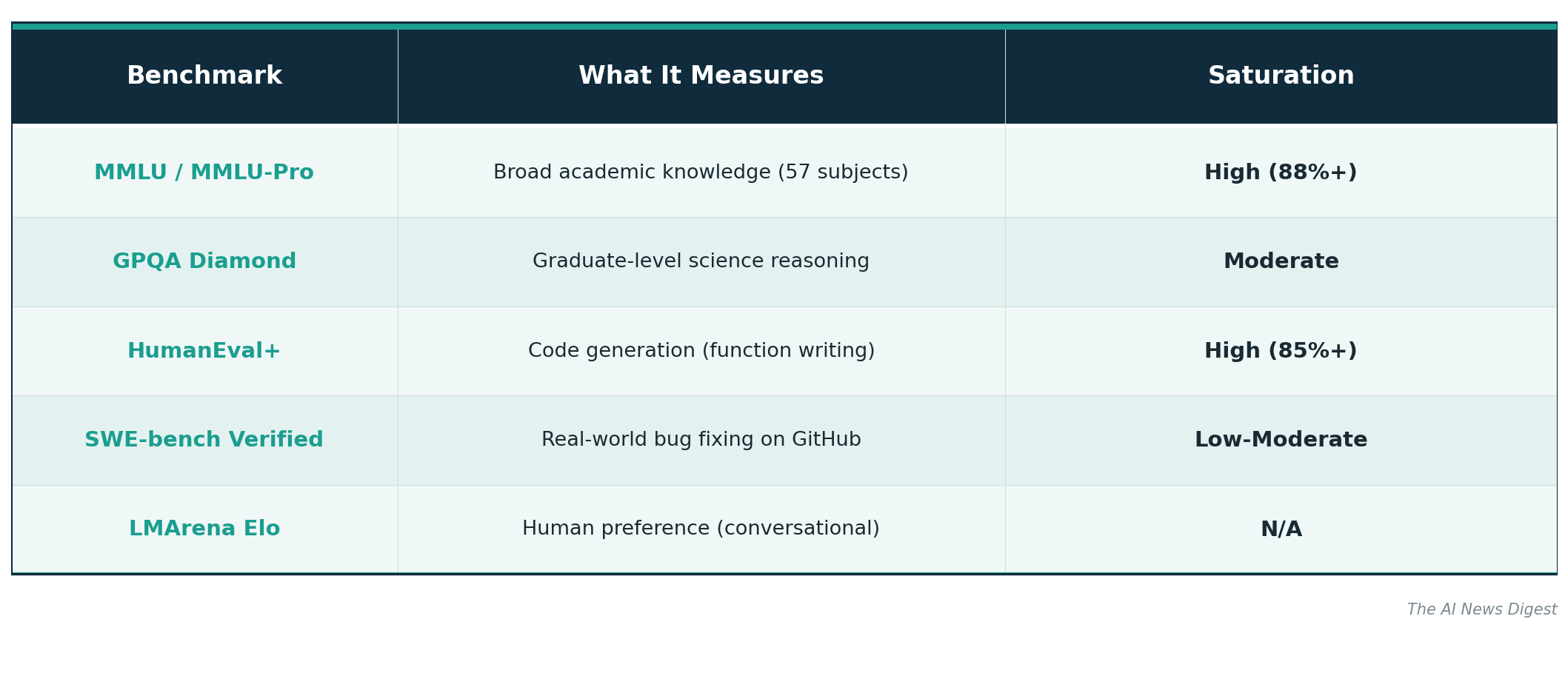
MMLU was useful when models were still learning factual knowledge. It is now too easy to differentiate frontier models. HumanEval tests whether a model can write correct Python functions from docstrings, but the 164 problems are relatively simple algorithms, not production code. Most frontier models score 85%+ and the differences are noise.
SWE-bench Verified is the current gold standard for code evaluation because it uses real GitHub issues that require understanding entire codebases. It is hard to saturate because the problems are complex, varied, and representative of actual engineering work.
GPQA Diamond remains one of the few knowledge benchmarks that still differentiates. Questions are created by PhD domain experts and validated to be genuinely difficult, even for other experts in the same field.
LMArena Elo captures something none of the automated benchmarks can: whether humans actually prefer one model’s output over another in open-ended conversation. Its weakness is that preference does not always correlate with accuracy, and the user base skews toward English-speaking developers.
Why Benchmarks Are Both Essential and Broken
The benchmark landscape in 2026 has a fundamental problem: Goodhart’s Law. When a measure becomes a target, it ceases to be a good measure. Model labs have become expert at optimizing for specific benchmarks without necessarily improving real-world performance.
The pattern repeats across every benchmark. A new evaluation is introduced. It differentiates models meaningfully. Labs optimize for it. Scores converge. The benchmark loses discriminating power. A harder version is introduced. The cycle starts again.
LMArena’s advantage is that it partially sidesteps this problem because the prompts come from real users, not a fixed dataset. But LMArena has its own limitations. The user base skews toward technical users who value different things than, say, a marketing team or a medical researcher. The “vibes” of a response (tone, formatting, length) can influence votes independently of substance. Model labs have been accused of optimizing outputs for conversational appeal, using techniques like generating more structured markdown or more confident-sounding language, rather than improving actual reasoning.
The Business of Benchmarks
A single leaderboard position shift on LMArena can influence millions of dollars in API revenue. When a model reaches the top of the Arena, developers try it. When developers try it, enterprises evaluate it. When enterprises evaluate it, contracts follow.
This is why competition in the benchmarking space itself is heating up. Scale AI launched SEAL Showdown in September 2025, a competing leaderboard that uses a broader, more diverse evaluator base and different methodology. Scale AI brings its data-labeling expertise to bear, arguing that its evaluators can assess factual accuracy and instruction following more rigorously than LMArena’s crowdsourced votes.
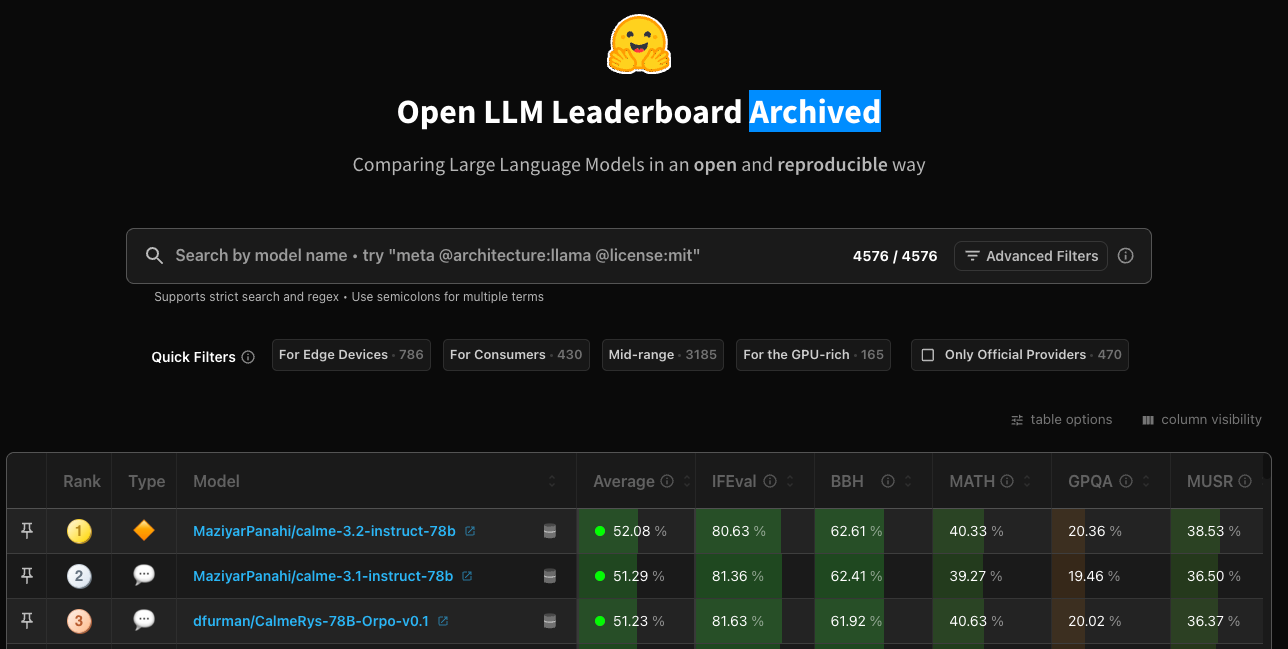
Hugging Face continues to run the Open LLM Leaderboard, now in its v2 iteration, which focuses on open-source models and uses a suite of benchmarks including MMLU-Pro, GPQA, MATH, IFEval, MuSR, and BBH.
Artificial Analysis publishes an Intelligence Index that combines quality benchmarks with pricing, latency, and throughput metrics, which is often more useful for procurement decisions than pure quality rankings.
LMArena’s $100 million raise signals that benchmark infrastructure is becoming a business in its own right. The company’s challenge is maintaining neutrality while generating revenue. If the platform that ranks models also sells services to the companies building those models, the conflict of interest becomes obvious. Hugging Face faces a similar tension with its leaderboard and model hosting business.
For anyone evaluating AI models, the best approach is to treat benchmarks as one signal among many. Arena Elo tells you about broad human preference. SWE-bench tells you about real-world coding ability. GPQA tells you about scientific reasoning. Pricing and latency data from Artificial Analysis tells you about cost efficiency. No single number captures whether a model is right for your specific use case.
Use them together, trust none of them alone.
Frequently Asked Questions
How many votes does LMArena have?
LMArena has accumulated millions of human pairwise votes across the leaderboard, with the count growing weekly as users vote on anonymous side-by-side model responses. The vote count is the foundation of the Elo-style ranking system and is part of why the leaderboard is treated as more credible than most automated benchmarks. Each vote is a human comparing two anonymous outputs and choosing the better one, which produces a different signal than synthetic benchmarks like MMLU or HumanEval.
Did LMArena spin out from LMSYS in 2025?
Yes. LMArena spun out from LMSYS (Large Model Systems Organization) in 2025 as a standalone company, raising the $100M round covered in this post. LMSYS itself originated at UC Berkeley SkyLab as the academic research group that created Chatbot Arena in 2023. The 2025 spin-out reflected the leaderboard’s growth from academic side project into industry-standard ranking system, which made independent commercial structure necessary.
Where did LMArena come from? UC Berkeley LMSYS origin?
LMArena originated as Chatbot Arena, a research project from UC Berkeley SkyLab researchers operating under the LMSYS group in 2023. The project let users vote on anonymous head-to-head LLM responses and aggregated the votes into a public Elo-style leaderboard. The transparency and human-in-the-loop methodology made it more trusted than self-reported model benchmarks. By 2024 it had become the de facto reference leaderboard for frontier AI models, and the 2025 spin-out plus $100M raise formalized the commercial path.
What is the LMSYS Chatbot Arena business model and funding?
Pre-spin-out, Chatbot Arena ran as an academic research project at UC Berkeley with no commercial business model. Post-spin-out, LMArena raised $100M to build commercial infrastructure around the leaderboard while preserving the public benchmark. The realistic 2026 monetization paths include enterprise model evaluation services, API access to the underlying vote data, custom benchmark deployments for AI labs, and consulting on model selection for enterprise buyers. The public leaderboard stays free; the surrounding services are the revenue model.
Where does Claude rank on the LMArena leaderboard?
Claude has held top-tier LMArena positions across multiple model generations, with Claude Opus 4.6 and Sonnet 4.6 typically appearing in the top 5 across overall and category-specific leaderboards in 2026. Specific rank shifts week to week as new models are added and vote counts grow. The post covers the surge in Claude’s benchmark positioning and what it means for enterprise buyers evaluating models. Check LMArena.ai directly for the current weekly rankings because positions change frequently.
Why is LMArena considered an influential AI benchmark?
Three reasons. First, the human pairwise voting methodology produces a signal closer to real-world model preference than synthetic benchmarks that test specific capabilities in isolation. Second, the open and transparent process (anyone can vote, votes are aggregated publicly) makes it harder for AI labs to game the rankings compared to closed benchmarks. Third, the leaderboard now influences enterprise purchasing decisions, which means model rankings have real revenue implications for AI labs. That commercial weight is why LMArena raised $100M and why labs invest heavily in performing well on it.
What does the LMArena $100M raise mean for AI model rankings?
The $100M raise gives LMArena resources to scale infrastructure, expand the leaderboard categories, and build commercial services around the benchmark. For AI labs, it means the benchmark is here to stay as an industry-standard reference, which raises the stakes of leaderboard positioning. For enterprise buyers, it means LMArena will likely become a more sophisticated decision tool than the current public leaderboard, with commercial offerings around custom evaluation, vote data access, and benchmark consulting. The 2026 trend: the leaderboard becomes a market-shaping force, not just a research artifact.
What Changed Recently (2026 Update)
April 2026: LMArena leaderboard continues weekly updates with new model additions. Claude Opus 4.6 and Sonnet 4.6 hold top-tier positions across multiple categories. GPT-5 and Gemini 2.5 Pro compete closely at the top.
Q1 2026: LMArena expanded category-specific leaderboards (coding, reasoning, multi-turn, vision) beyond the original overall ranking, giving enterprise buyers more granular model selection signal.
Q4 2025: LMArena spun out from LMSYS as a standalone company and raised $100M to build commercial infrastructure. The public leaderboard methodology stays unchanged; the spin-out formalizes the commercial path.
Methodology note: The leaderboard uses an Elo-style ranking system from anonymous human pairwise votes. Vote count grows weekly. Always check LMArena.ai for the current week’s rankings because positions shift as new models launch and vote counts accumulate.